I can't draw, so I learned to argue with an AI
Two weeks of making samurai with generative AI taught me something about who is really in charge.
In high school I ran a small business designing varsity jackets for my year. The business went well. The drawing did not. I had ideas in my head and stick figures on paper.
So when I spent the last two weeks making pictures with generative AI, it felt personal. Teenage me would have loved this.
It also felt like work, in a good way. I research how people and AI work together, and one idea kept popping up while I was typing “samurai” for the hundredth time.
Two dials, not one
We tend to talk about AI as a swap: the more it does, the less you do. I don't think that's true, and neither does the Human-Centered AI framework (opens in a new tab) my PhD built on. It says there are two separate dials: how much the computer does, and how much control you keep. You can turn both up.
Here's what that looks like with a samurai.
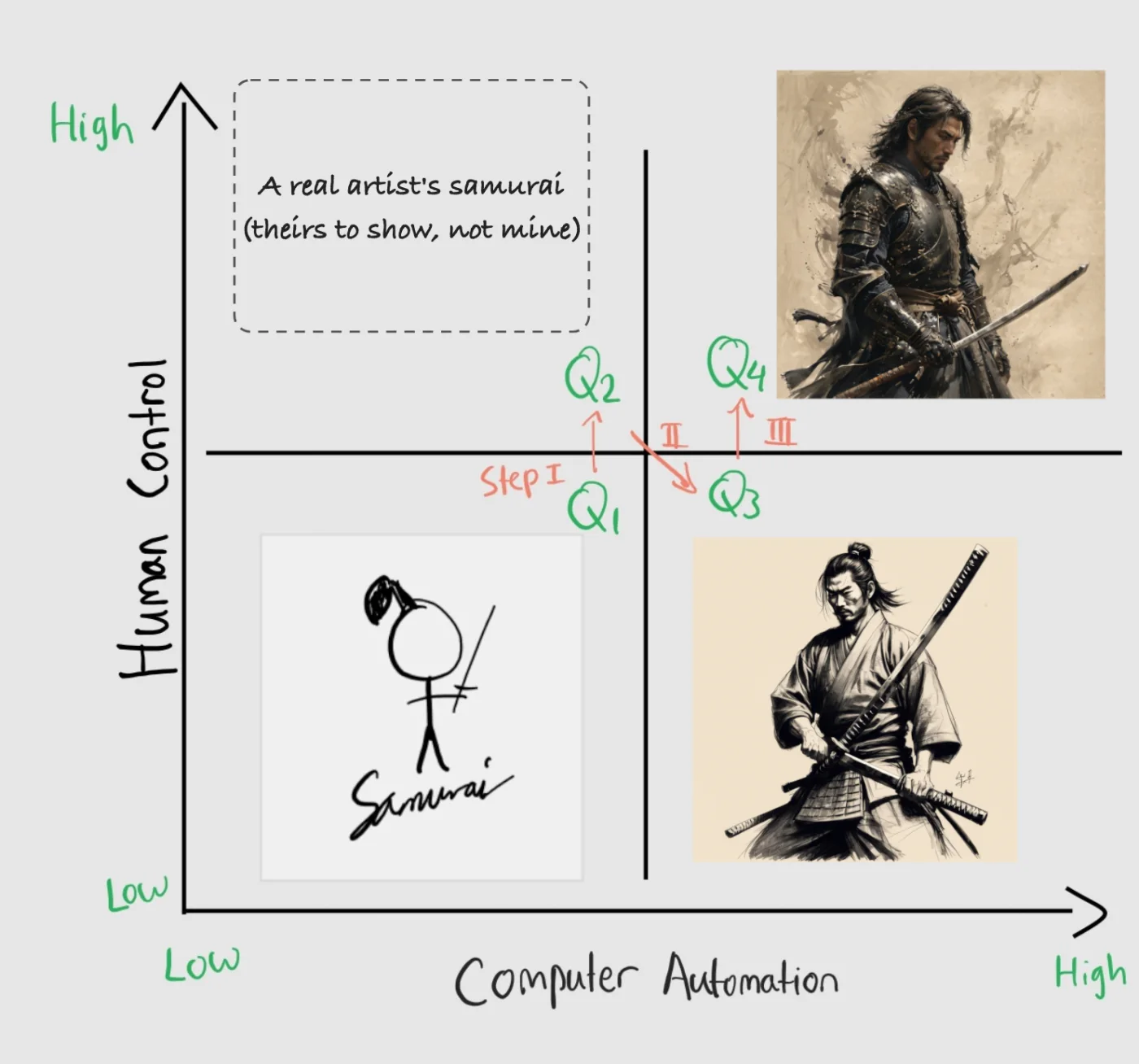
Q4 uses a style add on by HailoKnight (opens in a new tab).
Q1: a pencil and hope. No AI, not much skill. This is my natural habitat.
Q2: a real artist. No AI, lots of skill. I admire these people. Please pay them.
Q3: type and pray. You write “a samurai holding a katana” and a picture appears in seconds. It feels like magic, until you count the fingers. The swords in mine were bent in ways no blacksmith would allow. I kept adding words until my prompt was a whole paragraph, and I still felt like a passenger.
Q4: an argument you can win. The AI does a lot, and so do you. You choose the model, set how closely it follows you, sketch the pose, fix one corner, reject it, and try again. Then you touch it up by hand. These are the pictures that feel like mine.
Going from Q3 to Q4 was a steep climb, and worth it.
What I'm really adjusting
If you're curious, here are the words that confused me at first, in plain language.
- Model (or checkpoint): the brain you start with. Each has its own taste. Mine is called Juggernaut, and I follow this guide (opens in a new tab).
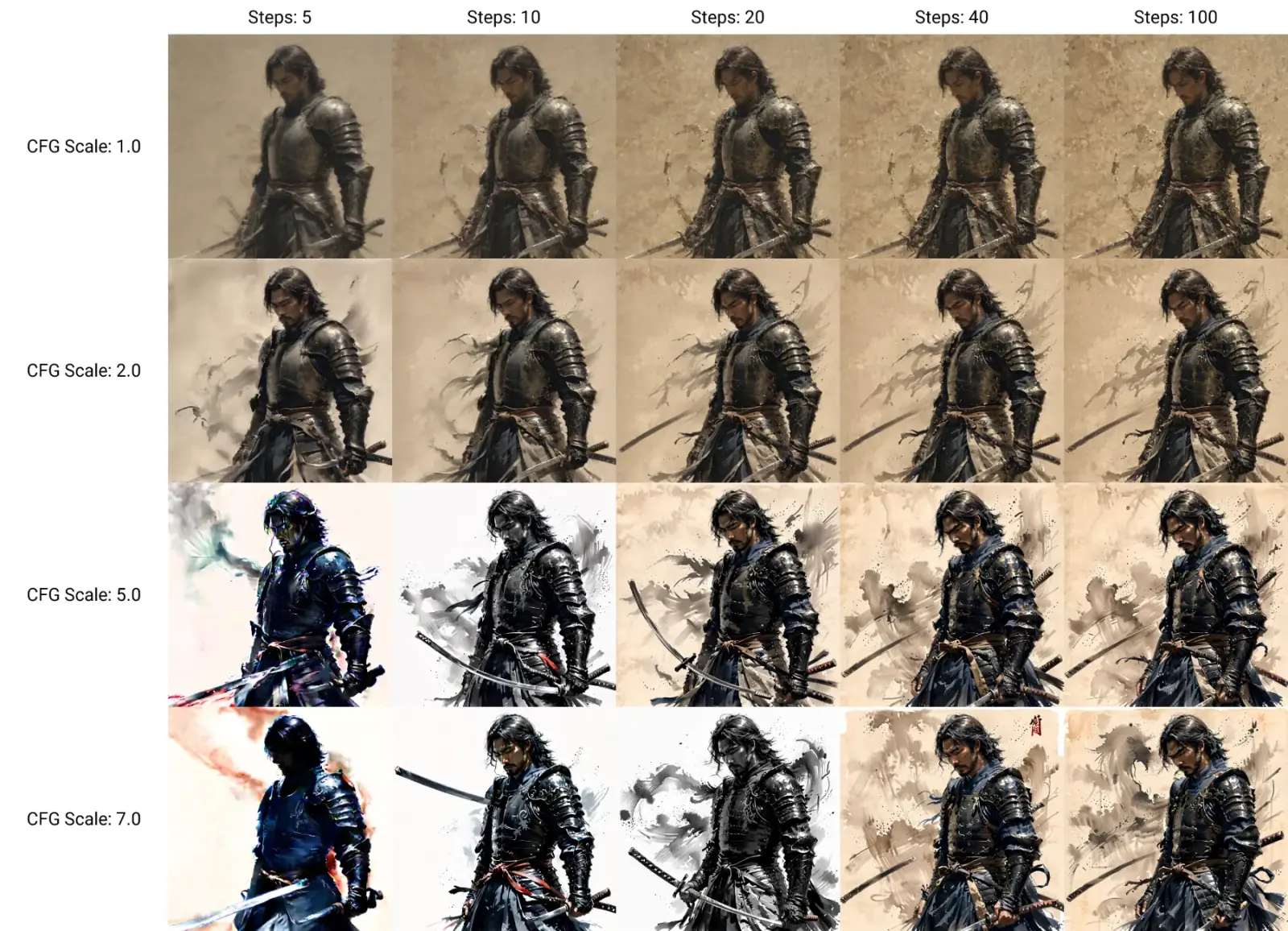
- Sampling steps (opens in a new tab): how many passes it takes over the picture. I use 30 to 40.
- CFG scale: how strictly it obeys you. I stay between 3 and 6, because lower looks a bit more real to me.
- ControlNet (opens in a new tab): give it a rough sketch and it keeps to the shape. Even a stick figure becomes useful.
- Regional Prompter (opens in a new tab): sunny sky here, dark forest there.
- LoRA: a small add on that teaches it one style or one subject. You'll find plenty on Civitai (opens in a new tab).
You can watch two of those dials at work here.
Want to try?
- Start easy. Midjourney or DALL-E will do. Nightcafe is mostly free, and the people are friendly.
- Practise describing things. It's harder than it sounds, and useful well beyond AI.
- Then take the wheel. Install AUTOMATIC1111 (opens in a new tab), and later ComfyUI (opens in a new tab) if you like knobs. Change one setting at a time and look at what happens.
- Find your people. Reddit's r/StableDiffusion is good for tips and for showing off.
What about artists?
I know this is a sore point. My view is that there's craft in Q4: picking tools, steering, knowing what to throw away. I hope AI adds to art rather than replacing the people who make it.
And what about school?
This is where I get a bit worked up. When people talk about AI in education, it's nearly always ChatGPT, and nearly always about cheating or saving time. These researchers (opens in a new tab) think that's too narrow, and I agree.
I teach software engineering, and I can think of better uses:
- A student describes a system in words, gets a diagram back, and has to find what's wrong with it.
- A student explains a dry topic with pictures or a short video.
- A class generates five versions of the same screen and argues about which is better, and why.
In each one the AI makes something and the student judges it. That's Q4 again. The thinking stays with the person.
There's a lot to sort out first: fairness, ethics, how we assess it all. But I believe the question “how do we stop students using AI?” has a better cousin: “how do we teach them to argue with it?”
I'd start with a samurai. Count the fingers.