Ask the students before you build it
Plenty of tools track how students learn. I think students should get a say in them, so we made a method for that.
Imagine someone builds an app that watches how you work, scores you and reports back to your boss. Now imagine nobody asked you about it first.
That's roughly how a lot of educational technology gets made. The field is called learning analytics: using data about how people learn to help them learn better. I work in it and I like it. But I think it often starts with “what can the technology do?” when it should start with “what do these people need?”
So my coauthors and I made a method to flip the order. It's called SLADE.
Two diamonds
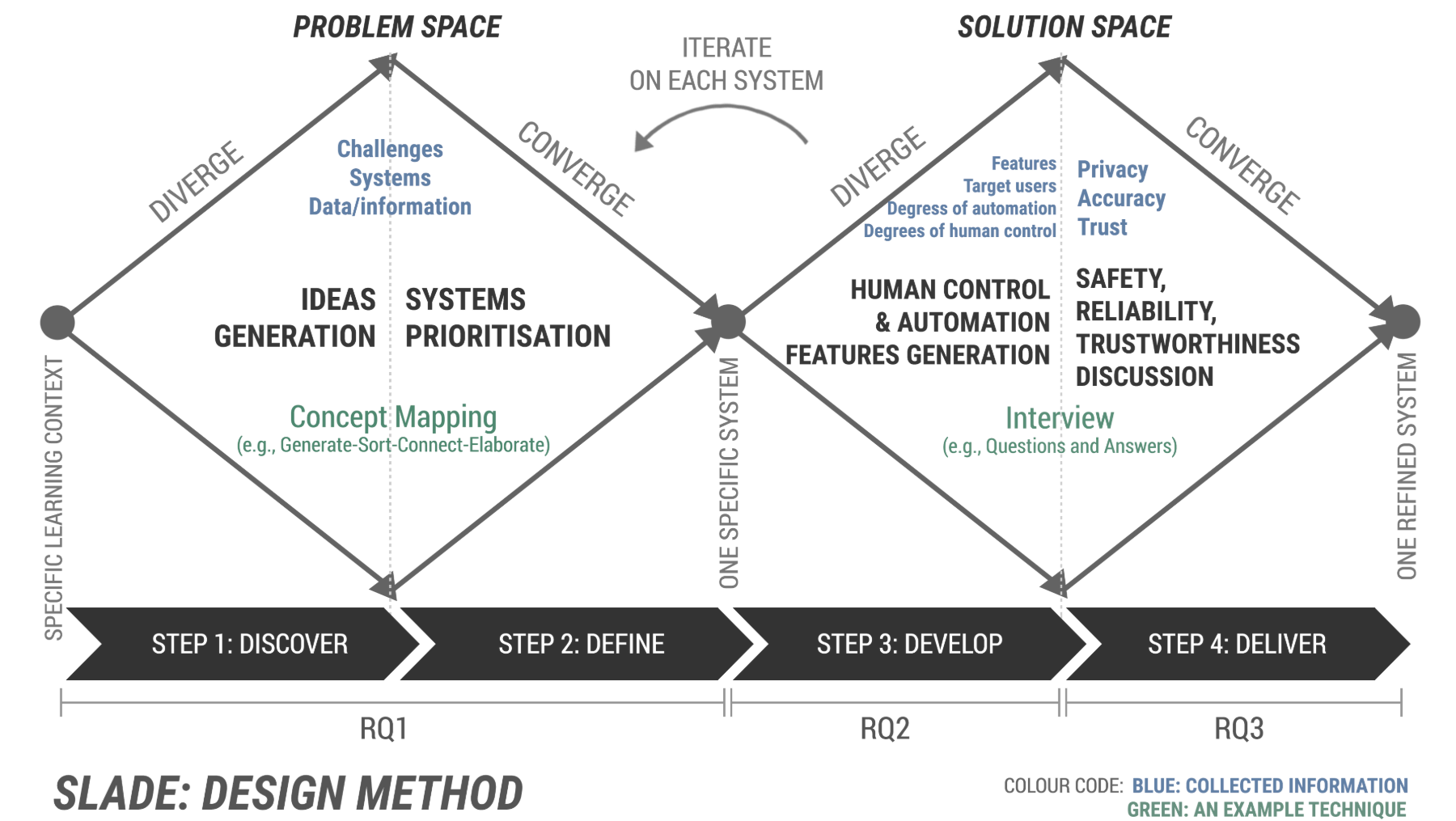
If you've seen the Double Diamond (opens in a new tab) from design, the shape will look familiar. You go wide, then narrow, then wide, then narrow again. In plain words, you sit down with students and ask:
- What's hard for you, and what could help? Collect everything.
- Which of these matters? Pick one.
- What should the computer do, and what should people do? This is my favourite question.
- What would make this safe, reliable and worth trusting? Fix it until you have a good answer.
Why step 3 is my favourite
People talk about automation as if it were a light switch. Either the computer does it or you do. I don't think that's right.
It's closer to cruise control. The car holds the speed, and you still steer, brake and decide where you're going. Lots of automation, lots of control, both at once. You just have to design for it, and you have to ask the driver.
We tried it
We used SLADE with students who learn to work as a team in healthcare simulations. We wanted to match tools to problems they really had, to hear how much say they wanted for themselves and what they would rather leave to their teachers, and to talk openly about trust.
I feel that's the conversation that's usually missing. Once a tool is built, the only question left for students is “do you like it?”, and by then it's a bit late.
It's not finished
We've tried it in one setting, and I'd like to see it in others. Teachers, learning designers and developers should be at the table too, and that's where we want to take it next. We also need to ask whether the ideas are practical and good for learning, not just nice on sticky notes.
If you build things for students, steal this method. If you only steal one part, make it step 3.
Read the paper
SLADE: A Method for Designing Human-Centred Learning Analytics Systems (opens in a new tab), LAK 2024.